
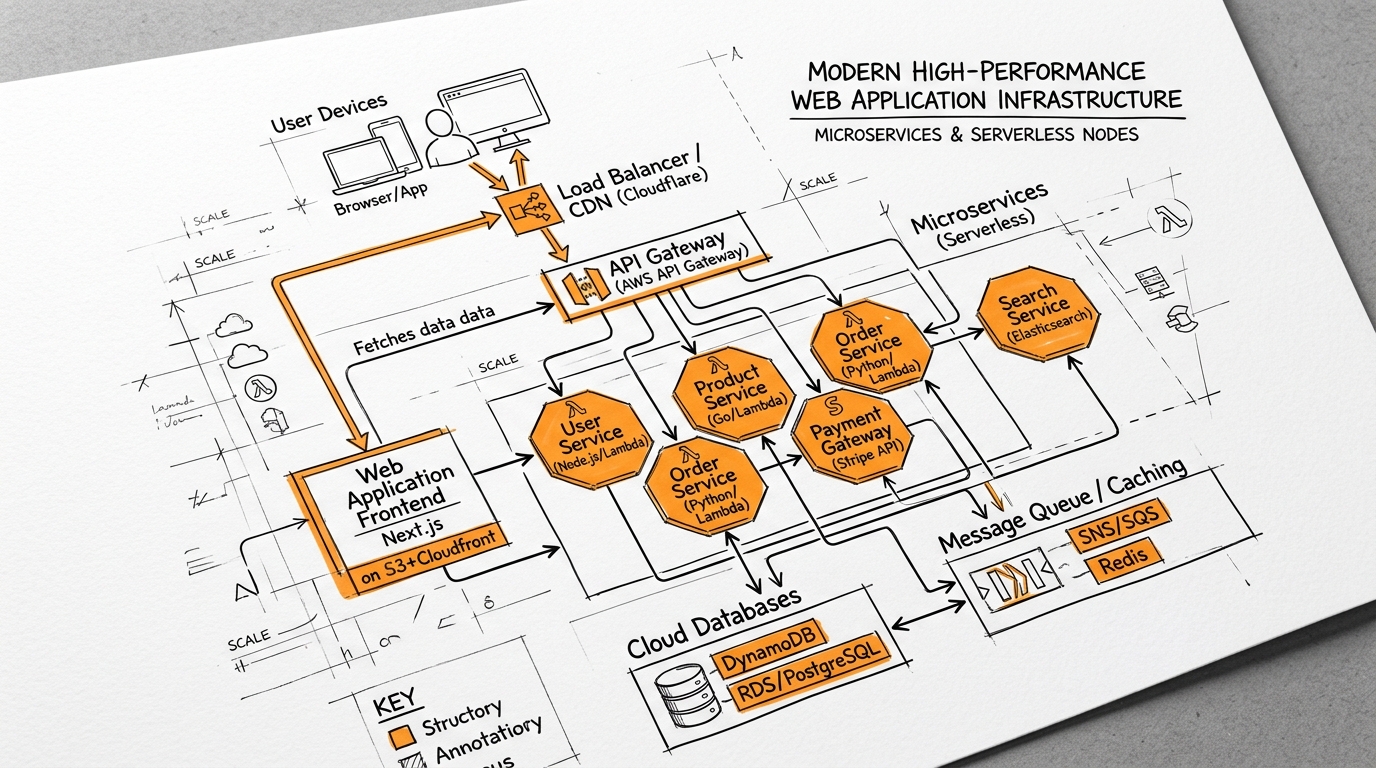
In modern cloud engineering, user expectations have outpaced traditional web architectures. A decade ago, a two-second page response was considered acceptable. In 2026, latency exceeding 200 milliseconds directly correlates with user drop-off, lower search visibility, and degraded transactional throughput. Scaling web applications to serve millions of concurrent requests demands an uncompromising architectural philosophy built on zero-latency event pipelines and distributed state isolation.
"Modern web applications don't fail under heavy load because of inadequate CPU compute; they fail because of unprincipled data fetching, architectural coupling, and lack of caching discipline," emphasizes Sophia Lin, Principal Systems Architect at Denovo. "High-performance software engineering is fundamentally about doing less work per request, not buying larger cloud instances."
Event-driven microservices and asynchronous work queues
Monolithic web architectures inevitably encounter bottlenecks when computationally intensive operations—such as PDF generation, automated invoice dispatch, image processing, or external analytics logging—are executed directly inside the synchronous HTTP request-response lifecycle. When hundreds of users initiate concurrent operations, application threads block, memory queues overflow, and database connection pools become exhausted.
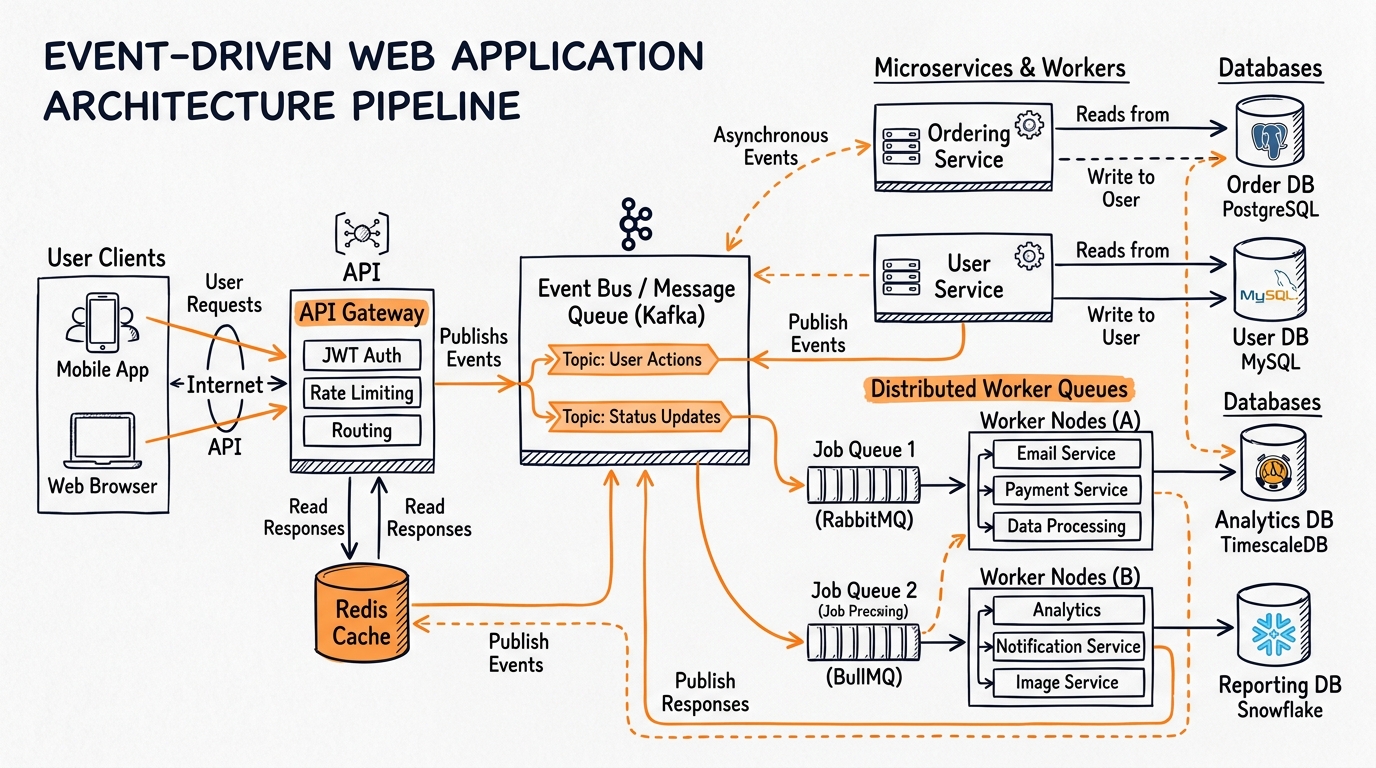
High-performance engineering solves this by strictly isolating synchronous user requests from asynchronous execution. As detailed in the Cloud Native Computing Foundation (CNCF) Architecture Guidelines, the primary API gateway acts as a lightweight ingress router: it validates JWT session credentials, applies rate limiting, writes an event record to an asynchronous message broker (such as Apache Kafka, RabbitMQ, or Redis BullMQ), and immediately returns an HTTP 202 Accepted payload.
Downstream worker pools ingest jobs independently from the message bus, scaling horizontally based on queue depth. If a payment webhook provider experiences intermittent latency or a document rendering engine spikes in memory usage, the core customer web application remains unaffected, preserving five-nines service availability.
The multi-tier caching hierarchy: Eliminating database thrashing
The slowest operation in any digital application is persistent disk I/O and relational database queries. When dynamic web pages execute unindexed SQL joins or repeat identical queries for static data, database CPU usage quickly spikes to 100%, causing cascading failure across all connected services.
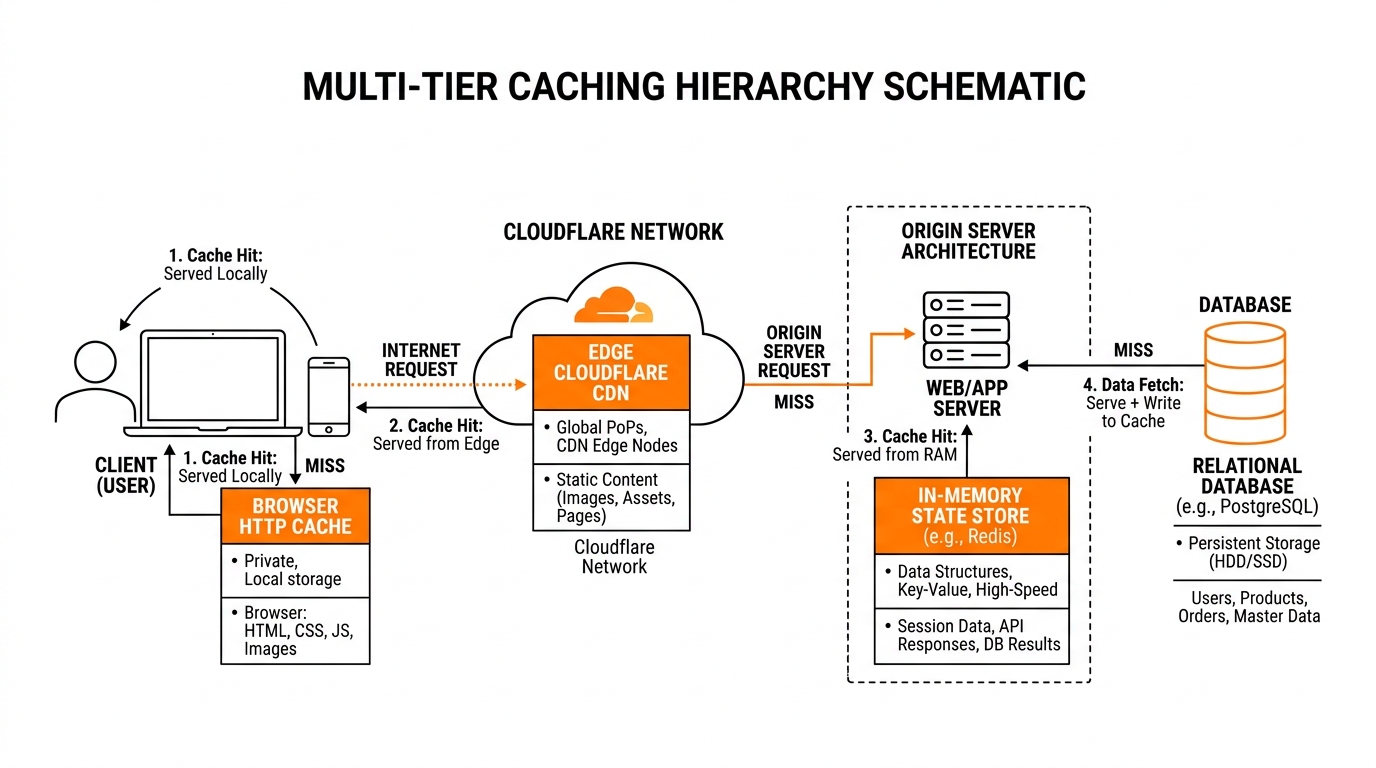
To eliminate database thrashing, high-performance web systems deploy a rigorous four-layer caching hierarchy:
1. Browser HTTP Cache: Setting strict Cache-Control: public, max-age=31536000, immutable headers with cryptographic content hashing for static assets ensures that returning visitors execute zero network requests for UI bundles.
2. Edge CDN Caching: Leveraging globally distributed points of presence (PoPs) via Cloudflare or AWS CloudFront allows read-heavy JSON payloads and HTML fragments to be served from servers situated within 20 milliseconds of the end user.
3. In-Memory State Stores: High-throughput Redis and KeyDB clusters maintain serialized session objects, authorization tokens, and hot query results entirely in RAM, resolving lookups in sub-millisecond intervals.
4. Relational Persistence Layer: Relational engines like PostgreSQL are fortified behind connection pooling proxies (such as PgBouncer) and distributed read replicas, guaranteeing that primary database write masters never handle unnecessary read load.
Guidance from the MDN Web Performance Documentation underscores that achieving an aggregate cache hit ratio above 95% slashes cloud infrastructure costs by more than two-thirds while providing instantaneous user experiences.
Frontend performance budgets and continuous profiling
Exceptional backend latency is meaningless if the client-side web application delivers a sluggish, bloated experience in the user's browser. The rise of heavy JavaScript component frameworks has led to widespread "hydration tax" — where browser threads freeze while parsing megabytes of compiled script bundles.
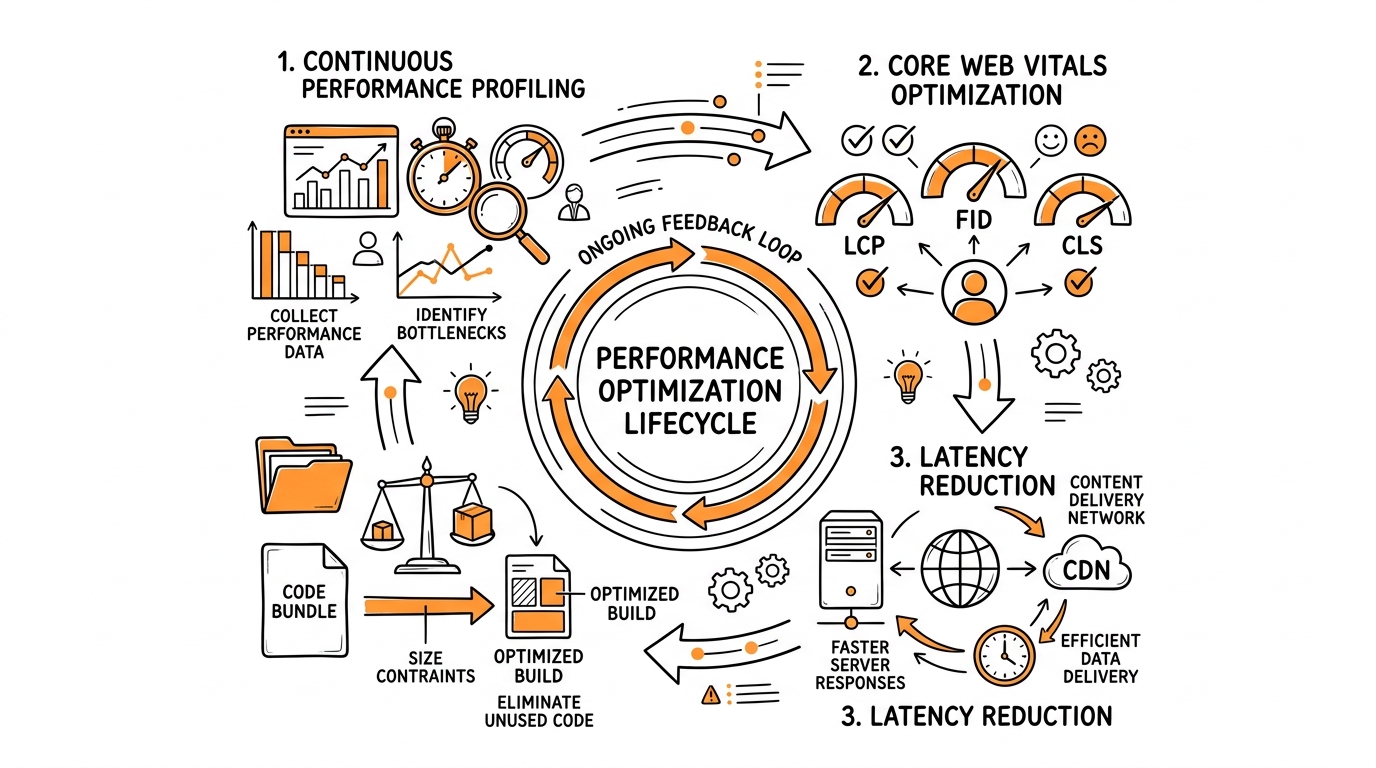
High-performance engineering teams enforce strict bundle size budgets during every pull request. Automated CI/CD gates verify that route bundles do not exceed 50KB compressed, mandating dynamic code-splitting and tree-shaking of unused library modules. Critical CSS is inlined directly into document headers, while non-critical fonts and analytics are preloaded asynchronously.
Furthermore, engineering pipelines integrate Real User Monitoring (RUM) agents that stream field performance telemetry directly to observability dashboards, tracking Google Core Web Vitals across geographic regions and mobile device tiers. Whenever Largest Contentful Paint (LCP) creeps above 1.0 second or Interaction to Next Paint (INP) exceeds 100 milliseconds, automated alerts trigger immediate regression triage.
Engineering resilience for modern scale
High performance is not a superficial feature added at the conclusion of a project; it is the fundamental architectural blueprint that determines whether a software product can thrive under modern market demands. By designing distributed systems that decouple synchronous bottlenecks, implementing relentless multi-tier caching, and maintaining strict client performance budgets, engineering teams build digital products that feel instantaneous, dependable, and virtually unbreakable.
At Denovo, our engineering philosophy revolves around these foundational principles. We build custom applications that empower founders to deliver elite, enterprise-grade digital experiences without inheriting crippling technical debt.